Emerging from our tents this morning, we found ourselves confronted with a breathtaking view of the rift valley with the Gamo Highlands shimmering in the distance. It was slightly shocking to realize that there were houses where we thought was total darkness the night before and how close to the edge of the mountain we actually were. We walked down to the main camp area and assisted in setting up the research tent and organizing all of the supplies. We had noodles for breakfast/lunch then made our way down to the cave for the first time. Upon walking to the cave, we were struck by three thoughts –
1)the cave was much bigger than we expected
2)the cave was so beautiful! Especially with all the overhanging greenery and the trickling waterfall across the mouth
3)the overall wow factor – the sense that, yes, we really were here in Africa.
We spent the morning learning how to use the Total Station that we will be using for plotting artifacts and mapping the various stratigraphy levels and structures. In the afternoon we began the tedious task of removing the entire fill deposited at the end of the last dig season to protect the site.
Tuesday, February 8, 2011

Monday, February 7, 2011
We left Addis early after another delicious breakfast and headed out to the cave. It was about a 5 hour drive and it was so interesting to watch how the scenery changed from an arid rather barren landscape, to miles of farmland as far as the eye can see, to a more tropical lush highland landscape. We napped on and off but never for long because there was always something new to see around the corner. Driving through the various towns was especially interesting. They all had signs saying ‘Bon Voyage!’ when you exited the limits.
A few times we had to stop and wait for sheep or donkeys to cross the road and as we drove through Hosanna, one of the larger towns, we saw several people crowded around a huge dead hyena, though whether it was roadkill or hunted we didn’t know. We arrived at the base of Mount Damota and had to wait for the others to go pick up food and benzene for the generator in Soddo. While waiting, we got to meet all of the school children who attended school at the base of the mountain. Christopher bought a foot of sugar cane stalk and the children showed us how to eat it. It was really quite hilarious.
Later, it was a dark and stormy night…no, really, it was. We arrived at the Moche Borago campsite just before sundown. The land cruiser had overheated 40km back so we had a late start getting up the mountain. The ride up the mountain was quite exciting. Not only was the scenery of the farm and countryside beautiful, but the terrain was rough and it was not unlike a ride at a theme park. Once at the top, everyone was in a whirlwind of activity. The Izuzu had arrived before us with all of our gear and we were all in a race against both the sunset and a brewing storm. The crew and workers were hurrying to put up the large dining and kitchen tents to store all of our supplies before the storm hit. While they were doing this, we, the students, set out attempting to construct our own tents further up the hill. At this point, it was nearly pitch dark out and the winds were gusting up around 40mph. They were using all of the hammers and tools to set up the larger tents so we used stones as hammers to set our tent stakes. “We’re using stone tools!” We were so proud of our ingenuity and the fact that it was relatively successful. We managed to get settled without falling off the mountain or getting lost in the dark and we curled up in our tents and fell asleep.
(photo by Andrew)

A few times we had to stop and wait for sheep or donkeys to cross the road and as we drove through Hosanna, one of the larger towns, we saw several people crowded around a huge dead hyena, though whether it was roadkill or hunted we didn’t know. We arrived at the base of Mount Damota and had to wait for the others to go pick up food and benzene for the generator in Soddo. While waiting, we got to meet all of the school children who attended school at the base of the mountain. Christopher bought a foot of sugar cane stalk and the children showed us how to eat it. It was really quite hilarious.
Later, it was a dark and stormy night…no, really, it was. We arrived at the Moche Borago campsite just before sundown. The land cruiser had overheated 40km back so we had a late start getting up the mountain. The ride up the mountain was quite exciting. Not only was the scenery of the farm and countryside beautiful, but the terrain was rough and it was not unlike a ride at a theme park. Once at the top, everyone was in a whirlwind of activity. The Izuzu had arrived before us with all of our gear and we were all in a race against both the sunset and a brewing storm. The crew and workers were hurrying to put up the large dining and kitchen tents to store all of our supplies before the storm hit. While they were doing this, we, the students, set out attempting to construct our own tents further up the hill. At this point, it was nearly pitch dark out and the winds were gusting up around 40mph. They were using all of the hammers and tools to set up the larger tents so we used stones as hammers to set our tent stakes. “We’re using stone tools!” We were so proud of our ingenuity and the fact that it was relatively successful. We managed to get settled without falling off the mountain or getting lost in the dark and we curled up in our tents and fell asleep.
(photo by Andrew)
Saturday, February 5, 2011
Layover Adventures
We had to change planes in Amsterdam, so to cut down on jetlag and get additional stamps in our passport, we decided to stay the day/night. At first I was enthralled by the city. It's so quaint and old-fashioned. As time went by though, I realized I was absurdly homesick. Not for America, but for Paris! Amsterdam is extremely similar but I was starting to notice the differences. Firstly, everything is English and considerably touristy. Secondly, the people are friendly. While both of these helpful when traveling I found myself distinctly missing the isolated "island unto oneself" feeling. Weird, but true. We went on a wonderful free tour (some new Euro-promo deal, they have them in almost every city and I highly recommend them) led by this hilarious Australian which basically took us around and through the red light district, the various coffee houses and churches eventually ending at the Anne frank house. I remember reading her story in eighth grade but it was still fascinating to actually see where it all took place. The steps hidden behind the staircase were so incredibly steep that it was like climbing up a ladder. I cannot even begin to imagine how difficult it was to live during those times. The second day we went to the rijiks and van goh museums. I loved the rijiks because it was multi dimensional. There were sculptures, pottery, weapons, boats, silver pieces, and massive dollhouses in addition to paintings. It kinda showed a history of dutch artistic culture which I thought was really cool. The van gogh was whatever. I am not a huge fan of paintings so I kinda zoned out after a while, but I did like how the museum was arranged so that you followed his life from beginning on the first floor to end at the top floor. We also went to the I AM AMSTERDAM sign which was super cool.
Outside it is absolutely FREEZING! all that cold weather blowing in from the North Sea. Taxis were no where to be found and would have been expensive anyways so we basically museum/restaurant hopped our way back to the hostel.
p.s. fun fact learned on the tour: there are more bikes registered in the city than there are inhabitants of the city.

Outside it is absolutely FREEZING! all that cold weather blowing in from the North Sea. Taxis were no where to be found and would have been expensive anyways so we basically museum/restaurant hopped our way back to the hostel.
p.s. fun fact learned on the tour: there are more bikes registered in the city than there are inhabitants of the city.

Friday, January 28, 2011
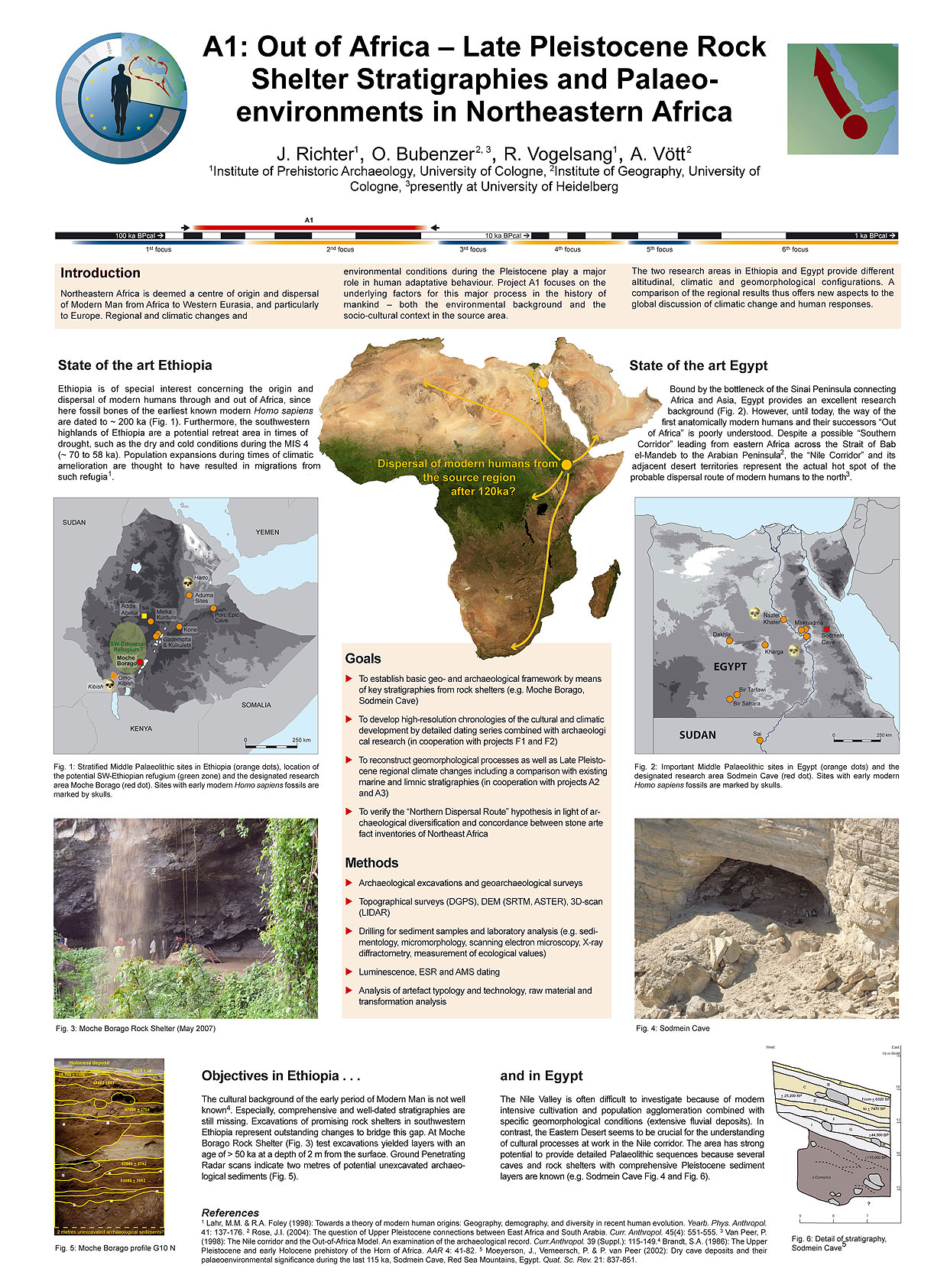
Project S.W.E.A.P
Here is the official project poster as used by the University of Cologne and found on their school website describing the goals, methods, and purpose behind the field excavation we will be participating in. Our excavations at Moche Barago cave (Fig. 3) are only a small portion of the overall program to explore an establish human mobility and migration from Africa into Europe.
There are currently 21 ongoing projects in various locations throughout Africa nad Europe. Our location in Ethiopia is important to the programme because it is considered one of the initial sites for the emergence of modern humans.
A full description of the overall project can be found here: Our Way to Europe

There are currently 21 ongoing projects in various locations throughout Africa nad Europe. Our location in Ethiopia is important to the programme because it is considered one of the initial sites for the emergence of modern humans.
A full description of the overall project can be found here: Our Way to Europe
Wednesday, January 26, 2011
1 more week
So it's pretty crazy to think that in one week we'll be on a plane to Amsterdam then Ethiopia a couple days later. It seemed so far away not very long ago and now it's here! I'm kinda nervous, very anxious, and mainly really excited. I have so many thoughts and ideas about what this experience is going to be like, but I feel like I have no idea what it will really be like. Over the past couple weeks with classes we've learned a lot, between flintknapping which is much more difficult than it seems and general things about African Archeology. I wish we would have talked a little more about our actual site before we left, but learning about Moche Borago on site will probably be even more useful.
Amsterdam! This is definitely an added bonus to the trip that I was not expecting at all. This is one of those cities that I've always heard about and all the crazy stories that go along with it. And now I get to go and experience it... to an extent! I'm much more excited for Ethiopia though. I've always wanted to go to Africa and experience life in a 3rd world country. It will open my eyes and really give me a different perspective on life that I believe is hard to grasp without actually experiencing it. I'm really excited to have time to hang out and play with the local children. I've got a soccer ball and a football packed and hope they will be down to play some pickup games! I think travelling after is going to be my favorite part. The opportunity to go backpacking and hiking in a place with so many different things to see makes one of my favorite hobbies even more appealing.
Well I'm super excited and I'm all ready to go, so one more week of hanging out and having fun then off for what will be the time of my life!
Thursday, January 20, 2011
So I finished getting all of my shots today! Im not a fan of needles but they were too terrible. Im not going to lie though, the Typhoid vaccine HURT! both shot itself and my arm for a full day after. It felt like a tetnus shot on steroids. I was really nervous about getting the yellow fever vaccine because my dad had a really bad allergic reaction when he had to get his but I lucked out with only having a slight fever, thankfully.
Today in class we were discussing somethings to do after we leave the campsite and we get to travel around on our own. I would really like to do a trek through the Simien Mountains. I think the scenary looks absolutely incredible and I really hope I get the chance to go here before I must fly home.
we were also discussing a few of the things the group did last year and one of them was eat raw camel liver, an apparent delicacy. Personally, I dont think I would have been able to do that. I can't even eat Beef tartare and I prefer my steaks medium BUT who knows maybe the crazy whim will seize me. doubtful, but possible. One of the kids going this year, Andrew mentioned that there'd been an episode on bizarre foods where they talked about eating raw meat in Ethiopia - Andrew Zimmern is braver than me
Today in class we were discussing somethings to do after we leave the campsite and we get to travel around on our own. I would really like to do a trek through the Simien Mountains. I think the scenary looks absolutely incredible and I really hope I get the chance to go here before I must fly home.
we were also discussing a few of the things the group did last year and one of them was eat raw camel liver, an apparent delicacy. Personally, I dont think I would have been able to do that. I can't even eat Beef tartare and I prefer my steaks medium BUT who knows maybe the crazy whim will seize me. doubtful, but possible. One of the kids going this year, Andrew mentioned that there'd been an episode on bizarre foods where they talked about eating raw meat in Ethiopia - Andrew Zimmern is braver than me
Sunday, January 9, 2011
First Day - Stone Knapping
Even though its a study abroad, I still have class two days a week. Today we learned how to make and identify stone tools.
According to Holdoway, S. and N. Stern in A Record in Stone, stone tools were once as common as coke cans and were used for everything from chopping down trees to skinning animals. Beginning as crude objects these tools evolved over time as we humans evolved intellectually. Stone artifacts are studied mostly because of their durability (few items can last for tens of thousands of years w/o deteriorating, as well as their variety. Stone technologies are a form of reductive technology in that they are created my the "irreversible decrease" in original mass of the object. in analyzing stone artifacts, scientists are able to determine the source of the stone, how the tool was created, and how it was used.
there are three primary parts: the hammerstone, the core, and the flake.
As the name implies, the hammerstone is the stone forcibly hit against the core which produces a break-off piece called a flake. hammerstones are usually made of a harder material such as quartz whereas cores are predominantly "softer" stones such as obsidian or other silica based rock. When struck, a flake breaks off along a fault line partially determined by the angle of the strike. as a result, a flake as several identifiable features: a platform (portion of original exterior where the core is struck, a bulge or bulb of percussion which is a direct result of the force of the blow and sometimes ripple marks can be seen radiating out in the direction of the blow as the force of the blow caused energy to travel through the stone until it reach the outer part of the stone whereby causing the flake to separate from the core.
it sounds rather technical but when we were given the opportunity to try out stone knapping ourselves, the attributes were more readily easy to see.
Contrary to our former belief, stone knapping is hard!! we worked with obsidian which is relatively brittle and very sharp. It was extremely difficult to get a perfect flake and to be honest I wasnt entirely sure what a perfect flake looks like. They all looked good to me. It wasn't until I'd been working on it awhile that I started to kinda get the hang of it. Its kinda like sculpting in a way i guess. You have to stare at a rock and decide what it is you want to create. You cant just start hacking away at it cause then you end up with just a bunch of broken rocks.
we then had to sort them upon our return from class into separate piles of flakes, cores, scatter, tools/flakes untouched, tools/flakes retouched, and then into proximal/medial/distal parts of flakes. Classifying the stones was really the most difficult part and only lots of practice will make it easier
According to Holdoway, S. and N. Stern in A Record in Stone, stone tools were once as common as coke cans and were used for everything from chopping down trees to skinning animals. Beginning as crude objects these tools evolved over time as we humans evolved intellectually. Stone artifacts are studied mostly because of their durability (few items can last for tens of thousands of years w/o deteriorating, as well as their variety. Stone technologies are a form of reductive technology in that they are created my the "irreversible decrease" in original mass of the object. in analyzing stone artifacts, scientists are able to determine the source of the stone, how the tool was created, and how it was used.
there are three primary parts: the hammerstone, the core, and the flake.
As the name implies, the hammerstone is the stone forcibly hit against the core which produces a break-off piece called a flake. hammerstones are usually made of a harder material such as quartz whereas cores are predominantly "softer" stones such as obsidian or other silica based rock. When struck, a flake breaks off along a fault line partially determined by the angle of the strike. as a result, a flake as several identifiable features: a platform (portion of original exterior where the core is struck, a bulge or bulb of percussion which is a direct result of the force of the blow and sometimes ripple marks can be seen radiating out in the direction of the blow as the force of the blow caused energy to travel through the stone until it reach the outer part of the stone whereby causing the flake to separate from the core.
it sounds rather technical but when we were given the opportunity to try out stone knapping ourselves, the attributes were more readily easy to see.
Contrary to our former belief, stone knapping is hard!! we worked with obsidian which is relatively brittle and very sharp. It was extremely difficult to get a perfect flake and to be honest I wasnt entirely sure what a perfect flake looks like. They all looked good to me. It wasn't until I'd been working on it awhile that I started to kinda get the hang of it. Its kinda like sculpting in a way i guess. You have to stare at a rock and decide what it is you want to create. You cant just start hacking away at it cause then you end up with just a bunch of broken rocks.
we then had to sort them upon our return from class into separate piles of flakes, cores, scatter, tools/flakes untouched, tools/flakes retouched, and then into proximal/medial/distal parts of flakes. Classifying the stones was really the most difficult part and only lots of practice will make it easier

Subscribe to:
Posts (Atom)